I have a large patch of marjorma and the honey bees just love it.
Bees on marjoram

Click on image to view.





I have a large patch of marjorma and the honey bees just love it.
Bees on marjoram
Click on image to view.

LADY OF THE MANOR – photo by Michael Peers
“She was a queen I took from a local nursing home. She had swarmed about a week earlier. She had settled on a branch of a tree at the back of the house. She was just one of many swarms to leave over the years I am told, I was informed that each swarm lands on the same tree and on the same branch at the same spot. The roof space of the home is very large and houses a large bees nest. The bees swarm about three or four times a season as the nest is very large and has been there as I am told for many years. Mike Forster had hived the swarm earlier in the day. He then telephoned me to meet him and swap it into my own nuc box. As I was a novice I found Mike’s help invaluable and would like to thank him for his time. The nursing home originally know as Selwyn house was built in 1594 and was used by King Charles the first during the seize of Gloucester. It sits at the foot of Robinswood hill and has a seperate church on the opposite side of the road. The house and the church are linked by a tunnel used during the seize. I would like to think that the bees had been there as long as the house but that is just wishful thinking.” – Michael Peers 2013


Bees – cleaning up frame after honey extraction by Richard Humphrey

For security, straps can ensure the individual hive boxes remain together. Sometimes animals such as horses, deer and badgers will attempt to knock a hive over!
Badgers are omnivores and will eat the grubs.
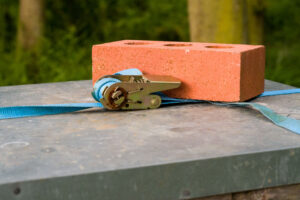
For added security a brick can be placed on the hive roof.
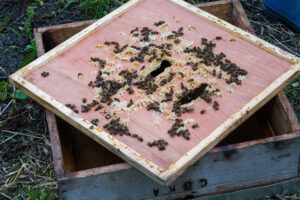
Good hygene practice of inverting the roof and placing hive components, such as the crown board, on top during inspections.
This prevents food product contacting the ground.
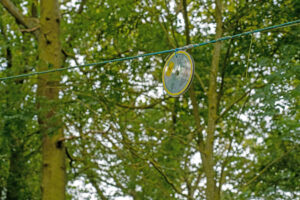
In a woodland setting, there is a risk of hives being attacked by green woodpeckers. Fortunately, they are easily spooked by shiny objects such as old CDs hanging on string between the trees.
Bees entering a hive.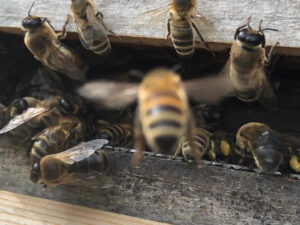
Image by Jennifer Lanham
Because the queen mates with many different males (drones) there can be big colour variations in her offspring.
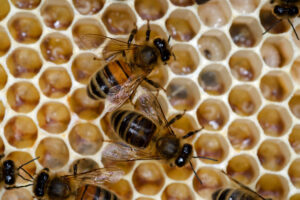
Workers feeding brood.
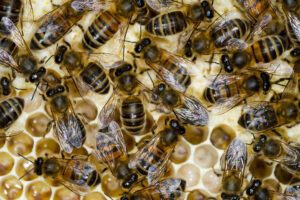
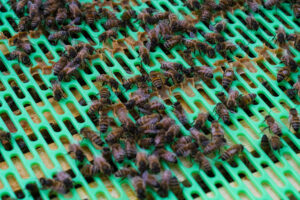
The green plastic queen excluder ensures the queen cannot lay eggs amongst the honey supers above. The slots are usually laid at 90 degrees to the frames.

An expanding colony.
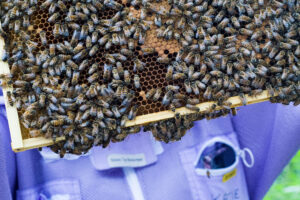
Inspecting a frame. Sometimes it is necessary to shake the worker bees off to see clearly what the frame contains.
With fewer bees on the frame, sealed and unsealed honey, and brood exposed, the pattern shows the queen has been at work and the larva are developing.

A closer look still. A magnifying glass and a small torch can help look deeper into the cells.
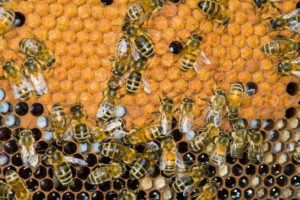
Ideally we are looking for brood at all stages: Eggs, larva and sealed brood.
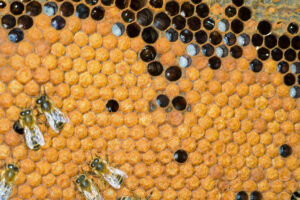
Closer-up you can see unsealed brood being tended by workers.
Under the magnifying glass, brood seems to be between 3 and 7 days old.
Drones, workers and queens develop at different rates.

Drones take 24 days, workers 21 days and the queen only 16 days.
By using this site you agree to our use of cookies. You can see our privacy policy here.
Manage your cookie preferences below:
Essential cookies enable basic functions and are necessary for the proper function of the website.